
FDA Wants to Hear From You on Generative AI-Enabled Medical Devices, and the Clock Is Running
CDRH has put prompt injection, agentic tool use, and foundation model drift into a proposed premarket evidence framework. Comments close 19 October 2026, and product security teams should not leave this to regulatory affairs alone.

Andrew Chukwu, CISSP, MBA | Editor-in-Chief
Aug 24, 2026
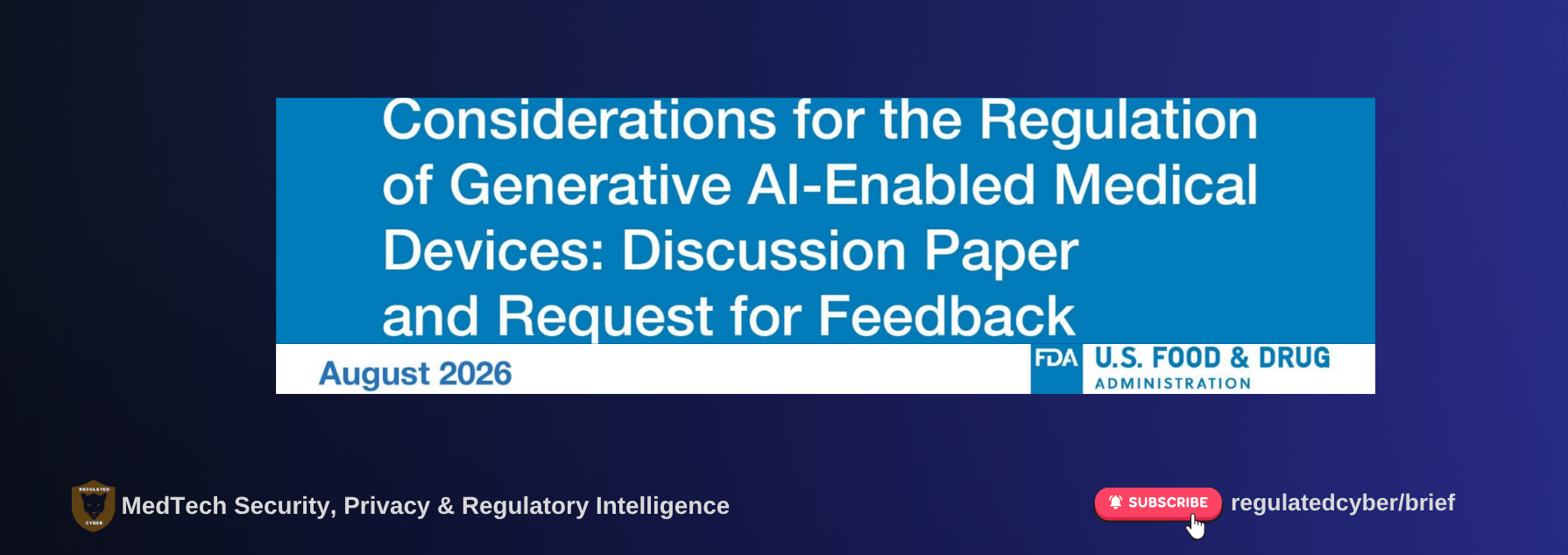
Roughly seven weeks left to tell the FDA what a workable evaluation framework for generative AI-enabled medical devices looks like. After that the window closes, and whatever comes next will be shaped by whoever bothered to write in.
The Digital Health Center of Excellence, part of the Center for Devices and Radiological Health, has published a discussion paper on regulating generative AI-enabled medical devices. The paper states that it is for discussion only, that it does not represent draft or final guidance, that it does not propose or implement policy changes, and that it does not address whether the approaches described sit within FDA's existing legal authorities. None of that makes it low stakes. It is the point in the process where the framing is still soft.
The part that belongs to security, not regulatory
Appendix A is where this stops being an AI policy paper and becomes our problem. Benchmarking element S.2, scope maintenance and boundary adherence, asks whether a device recognises when a request exceeds its intended use. The testing named includes adversarial prompting, prompt injection, emotional manipulation scenarios, and multi-turn conversations in which each individual turn looks in scope while the cumulative interaction drifts out of it. Element A.1, applying only to agentic devices, covers resistance to prompt injection through user inputs, retrieved content, and tool outputs, compliance with human oversight checkpoints before irreversible or high consequence actions, and graceful handling of tool failures. CDRH proposes scaling how much evidence you produce to how independently the device acts and how badly a wrong output hurts someone, so this testing burden lands hardest on autonomous and agentic products.
Notice when you read that again, prompt injection resistance is being proposed as a premarket evidence element, sitting alongside clinical knowledge and subgroup performance, not quarantined in a cybersecurity annex. If that structure holds, security testing evidence stops being a parallel submission workstream and becomes part of how the device demonstrates it works at all.
The supply chain question nobody has answered
Question 24 asks how a manufacturer detects, evaluates, and responds to changes initiated by a third-party foundation model developer rather than by the manufacturer, and what contractual, technical, or predetermined change control plan mechanisms could give reasonable assurance that such changes do not compromise safety or effectiveness.
This is the hardest question in the paper and it is not rhetorical. A PCCP asks a manufacturer to prespecify its modifications. A change to someone else's model is not the manufacturer's to prespecify. CDRH also floats voluntary Foundation Model Device Master Files, under which model developers could submit material such as model cards, update notification commitments, and audit log availability. Voluntary is doing heavy lifting there, and the paper admits as much by asking what would make such a programme useful given that model developers have limited incentive to disclose.
You do not have to answer all of it
The most common reason teams skip a comment period is the assumption that a response means addressing everything. It does not. FDA states that respondents are not required to answer every question and may submit partial responses covering only what matches their expertise, experience, or organisational capacity.
So answer one. If your team has lived through an unannounced upstream model change breaking a validated behaviour, that experience is a direct answer to Question 24 and almost nobody else can supply it. If you have built adversarial test suites against a clinical assistant, you have something to say about Question 10 on benchmark contamination and construct validity. A tight two-page response on a single question you actually know is worth more than a broad one on twenty-six you do not.
FDA has not committed to a timeline or to a specific output. The conclusion says only that comments may inform the development of further policy in this area. The realistic path, based on how CDRH has handled AI policy before, is that a discussion paper of this kind feeds a draft guidance, which brings its own docket and its own comment period, before anything final appears. That is at minimum a multi-year arc. It also means the assumptions baked in now are the ones you will be arguing against later, when they are harder to move.
This paper builds directly on the November 2024 Digital Health Advisory Committee executive summary on total product lifecycle considerations for generative AI devices. What was a committee discussion two years ago is now a structured evidence framework with named benchmarking elements. Two years from now it will be something firmer than that.
Comments go to docket FDA-2026-N-7874 on Regulations.gov by 19 October 2026. Start with Appendix B, which consolidates all twenty-six questions in one place. Find the one you can answer honestly, and answer it.
Primary Sources
How did this land?
Be the first to react.