
FDA's updated eSTAR Template: Which Version to Use, What Changed, and What to Do If You Already Have an AI Letter
eSTAR 6.2 was retired on August 3, 2026. New submissions belong on 7.1, files under review stay where they are, and one unchanged cybersecurity question still triggers technical screening holds.

Andrew Chukwu, CISSP, MBA | Editor-in-Chief
Oct 11, 2026
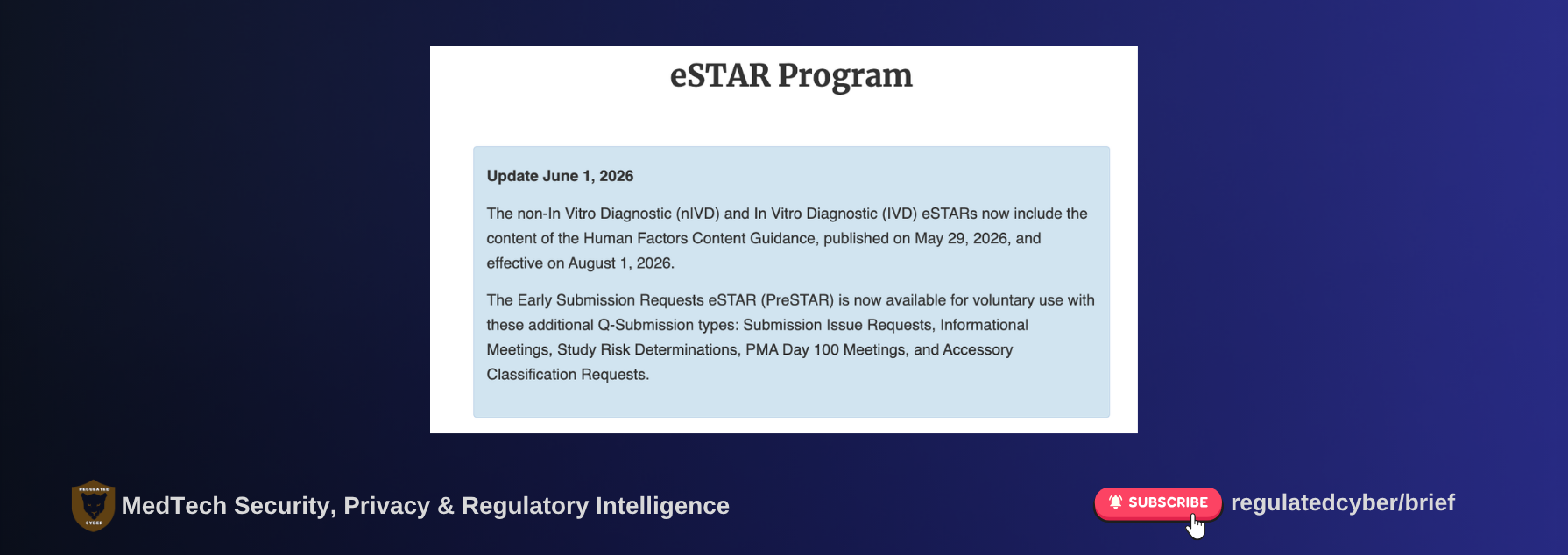
The US Food and Drug Administration has updated its electronic Submission Template and Resource (eSTAR), the template required for most 510(k) and De Novo submissions. Version 7.0, a major update built around FDA's new human factors content guidance, was released on June 1, 2026. Version 7.1, a minor update, followed on September 21 and is now the current template for non-in vitro diagnostic (nIVD) and in vitro diagnostic (IVD) devices.
Which template applies now?
Submissions not yet filed now need to use version 7.1 and FDA states that minor version differences do not usually lead to additional information requests, so a submission file built on 7.0 can be filed as it is. A submission file still on 6.2 might not be rejected, but because 7.0 was a major version, FDA may raise AI requests on the changes where they apply to the device, most likely human factors.
What happens to submissions already under review?
Once FDA issues the acknowledgment letter, a submission is tied to the eSTAR version on which it was filed. Responses to an AI request or a technical screening hold go into that original file, even if it is on 6.2.
What changed in versions 7.0 and 7.1?
Version 7.0 adds a Human Factors subsection to Performance Testing, reflecting the human factors content guidance that took effect on August 1, and allows applicants to insert and reorder Standards and Additional Information responses. Version 7.1 adds verification checks to administrative fields, removes the optional Intended Population question, clarifies how to handle human factors in a Special 510(k), and makes minor EMC edits.
How about the cybersecurity section?
The cybersecurity section requests the same content as it did in 6.2, and FDA has recorded no cybersecurity change since July 2025. Submission packages prepared against the February 3, 2026 premarket cybersecurity guidance need no restructuring. However, there's one question that deserves attention. The SBOM subsection asks for the device's operating systems and versions, and its help text states that listing an operating system that is unsupported or nearing end of support will generally be considered an inaccurate response. An important point to consider as you prepare for your next submission.
Where technical screening holds arise
An inaccurate response, or attachments that are not relevant to the question, can place a submission on technical screening hold for up to 180 days, after which FDA considers it withdrawn. Three risks stand out here:
An operating system that loses vendor support between design freeze and submission turns an accurate answer into an inaccurate one, a point the premarket guidance also makes when it asks for each component's end-of-support date (See section V.A.4, page 17).
An incorrect dropdown answer can hide questions that should have been answered.
And when a draft is migrated using Export Data and Import Data, attachments do not carry over.
Worth keeping these in mind.
Recommended actions for regulatory and product teams
For teams preparing a 510(k) or De Novo submission, or answering FDA on one already filed, here are a few points to check:
Download 7.1 from the FDA eSTAR Program page and confirm the version number on the first page.
Migrate any 6.2 draft using Export Data and Import Data, then reattach every file.
Complete the Human Factors subsection where it applies to the device.
Check each listed operating system against the vendor's end-of-support date, looking ahead to the expected end of FDA review.
Review dropdown answers from the start so no required section is hidden.
Answer any AI letter in the original eSTAR, without changing versions.
Before you submit
Confirm the template version and the operating system answer before any eSTAR is filed. Both checks take little time, and together they remove two avoidable routes to a 180-day technical screening hold.
References
How did this land?
Be the first to react.